Author: @jcm3rockstar
A Snap-shot, a Presentation…
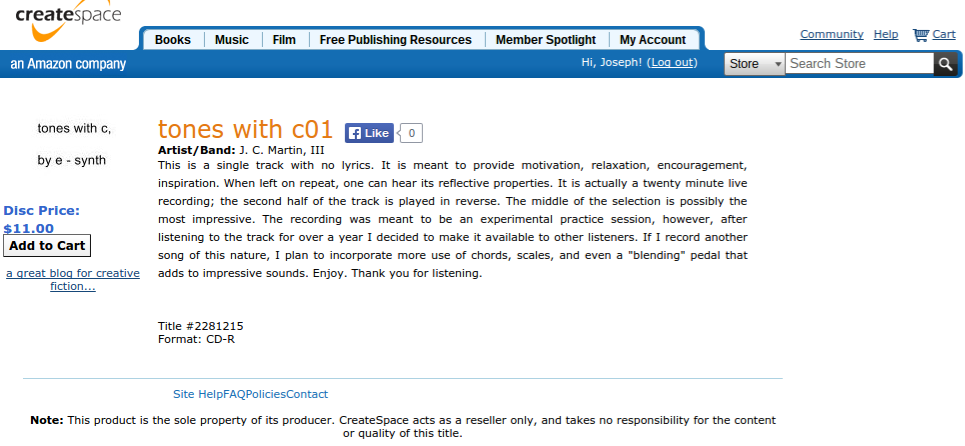
The above image makes me happy – it means that I will, eventually have a song available for you. I may also be able to present an even better song, eventually, that may sound similar. This is a forty minute song that will be available for order by mail as a C.D. It was originally an experimental practice session, however I listened to it for about a year and enjoyed it, decided to share it, somehow. “tones with c” has no lyrics; one can sleep or dance to it.
The second half is the first half reversed, sounds fun, especially on repeat. I am happy that it will be possible to share; the title and upc numbers will be the same when it is available within ten days. It is an electronic piano recording with basic ‘synth’ beats as ‘metronomic’ rhythm. Though not as exciting as many nin albums or other professional music discs; I hope you check it out. Happy blogging!
A Frantic Day
A Frantic Day
“I have to get these thoughts down,” thought our Miserly; “Must find a place for expedient jotting…” She had been skimming through a periodical on writing all morning – the forty-five minute rail-ride was over. The periodical had some very inspirational notions, indeed; she could but not resist reading its every article. An excited writer, Miserly kept pursuing more technique. “Well developed characters,” she thought, “A beautiful scene, some things occur, and then… wham! Of course, the aftermath.”
So many things to do on her day off, she put them mostly aside. Miserly was seventeen and brilliant. She jogged to her nearest library and found a quite, lowered desk in the shape of an amoeba, by a large and dull window, without too much external distraction, after signing in. “A protagonist, a problem, and a solution,” she thought.
“His name was Paul Goodman…” she wrote. As she began to scribe in a hurried but quick and legible manner, a library worker strolled by, giving Miserly a nonchalant glance. Miserly knew she must return a nod, or unknown things may occur. The worker nodded in return, seeing she (Miserly), though frantic, was up to nothing worse than writing.
Miserly described Paul and his plight well. He was a man in between jobs and in need of one soon. She alluded to Paul’s selfless desire to live a better life, to work well and provide assistance to those in need, somehow. It was 4:30 AM. Paul was on a city sidewalk, and he would have to try to keep himself in proper demeanor to get a good job. No one would hire him looking exhausted, unkempt, slipshod.
Mr. Goodman’s thoughts were to attain a newspaper and tidy up quickly in his flat. He would then pursue something on foot from the classifieds. As he strolled toward a metal newsstand box, two things occurred. A worker opened the newsstand box to place the papers in the device, and a small car ‘t-boned’ a duly only forty feet away.
Paul made his way quickly to the worker and said, “I would like to buy a paper before you close that box. Please, kind sir.” The worker’s name was Mr. Whirley. He was an assistant editor who happened to still fill the paper boxes once a week, as he did long ago. Mr. Whirley handed him a paper; took out a small camera and took a picture of the accident as the drivers were making their exodus from the two vehicles; let Paul put his change in the machine; and asked, “What is the hurry with your wanting a paper? Eager to know the weather?”
“I am in desperate need of a job and am open to most anything legitimate that will pay,” said Paul, “I lost my job and have personal responsibilities.” “We just had two people leave our department last week,” said Mr. Whirley, “We need a ‘Proofer.’ Do you have any experience in editing, whatsoever?” “Not professionally,” said Paul, “I am an avid reader of novels, however.” “Who is your favorite novelist?” asked Mr. Whirley, as he took another picture of the drivers approaching.
“I like the more famous authors and like their style,” said Paul; “My favorite author is currently Stephen King.” “What would you think about a ten-day temporary job, six hours a morning?” asked Mr. Whirley, “We need the help; I like your enthusiasm; and if you do well we should be able to keep you around. We need no errors in our articles.” “I would love that and thank you,” said Paul, considering this offer to be a blessing. He and Mr. Whirley shook on it, and Mr. Whirley said, “Respond to the ad in the paper that mentions my office before noon, today, and you just may have yourself a new job.” “Thank you good sir,” said Mr. Goodman, “I do appreciate you and will be there.”
By then the two drivers both asked the two gentleman conversing if they had seen the accident. They both agreed that they saw what had happened – the driver of the small car failed to heed to a yield sign. Mr. Whirley had pictures he was sure would be requested for by his paper, the drivers, and their insurance companies. Thankfully, no one was injured badly. Before the four people spoke too much about whether anyone was right or wrong, the police pulled up – two cars. They filed a report; the drivers drove away with the small car receiving a citation; Mr. Whirley went back to work to write up an account for the paper; and Paul went to take a shower.
Paul got the job that day around 11:30 AM and did so well for the first two years that he bought himself an expensive digital camera to celebrate his achievements. He took up photography as a hobby and even took pictures for the paper and various periodicals from time to time. Ten years later, he was still loving his job and turned down retirement to work at least one more year.
As for the drivers involved in the accident, they had sore necks, yet they were fine within two weeks and ended up attending the same religious congregation consisting of over 650 people. The story was what it was to Miserly, meaning that she liked it, hoped others would enjoy it, too. She had finished it and enjoyed the idea of the worried man finding a job and doing well – he got to play with a nice new camera, too.
She decided it was short and sweet, good enough to submit to the literary publication she was reading through that morning. She revised her fast-written prose as the 70’s style orange chair creaked as she leaned back in it, knowing she had the better part of twelve entire minutes to finish the revision before having to ask for an hour extension from the librarian. No one ever enjoyed asking for an extension. Such an ordeal was the very inspiration for coming back on another day – without question.
Miserly quickly revised her story, re-writing one or two sentences completely, to promote better concision and more proper diction, according to what just had to be more accurate. She was rather impressed with the story and had one minute left. Looking up, she saw an older woman, a library attendant, coming her way. The worker could have been walking in slow motion. From her attentive reading, Miserly could not see the woman very clearly.
A young man with the semblance of an intelligibly cute elf was walking and reading at the same time – in a library. Confused, Miserly wondered if she was dreaming. She was not, however, and just as the librarian was about to speak in a loud manner toward Miserly, the young man walked right into the woman, startling them both.
“Pardon me, ma’am,” said the young man, “I am so very sorry.” The older woman was ‘ruffled,’ indeed, and Miserly escaped on foot while managing to toss over a wicked grin to the young man. He gave her a confident nod. He was cool. “I will have to submit this story by mail before noon,” thought Miserly, “Hopefully, the magazine will love it. I have so much to get done.”
She made it out of the library. She ran into the young man again later in life and they became close companions, both given to the art of literary composition. The periodical helped Miserly extend and revise her story for a small fee; it was published and praised; and her audience waited for her every word.
Intellibots, Story One
One night a dreaming chemistry student gazed upon the stars. His name was Sean; he was up late. He had a lot on his mind. He had an avid and working knowledge of computers, the periodic table, and biology. What set Sean apart from many other students of science was his understanding of biology and metallurgy. Stemming from ideas of nickel-plating, he could prove with written theory how to turn biological matter into metals and gels and other forms of living and non-living material.
He could change common animals into living hardware. Existing as a humane being, though, how could he use his theories to the benefit of other beings’ understanding? He wanted the money for it, and he did not want to feel any ethical guilt. “I will design a pharmaceutical artificial intelligence robot pill,” he thought, “Like many other theoretical ideas, this pill will chemically change animals into an monitorable animal-bot.” He thought on the topic for some time, and Sean considered the various dictionaries he could use in computing from his side-studies of artificial intelligence.
“How else could I monitor brain-wave function and communicate with other forms of life?” he wondered. He went inside and found a mechanical pencil and a sketchpad. He quickly wrote down a design for a pill, including the chemical reactions to back up specific “proci”, a term he used for the plural form of the word process. “I wonder what might be a good choice for a first animal,” he thought, “A cat!” he said aloud on accident.
A cat it was. He had a female neighbor named Ann. Ann was an art design major with an expensive kitten she called Floofa. She said Floofa was a “Siamese snow cat.” “Floofa will be a great prototype for my first robotic artificial intelligence communications and behavioral learning pill,” thought Sean.
He continued exhaustively with his rough writings related to biological chemistry, metallurgy, and anatomical sketches of a young kitten for at least three quarters of an hour. Sean went and finished the rest of his real schoolwork, as he was pursuing a bachelor’s degree in chemistry and considering pre-med, before he turned in. The next morning Sean woke early and attended his classes. He took notes and turned in his assigned work; he thought of Floofa. That afternoon he went to the chemistry lab with his sketches – they were the design for his first pill. “I will call these animals Intellibots,” thought Sean, and he worked into the night.
By 9 PM that day, he had designed the perfect pill for Floofa. The epicenter of the pill contained a tiny bio-metallic sphere. The stomach acids of any feline would react with the pill to start its primary and secondary reactions. All secondary reactions would deal with RNA, connectivity, and longevity for the eventual adult cat. Primary reactions would cause the cat to have reduced cylindrical areas in its main functioning bones in order for the development of titanium wires. These wires, unseen, would resemble alien technology. The wires would connect to various other smaller wires of new metals for communication purposes, as well as “physical action technique” reasons.
The pill would develop inside of the kitten into a sort of radio with communication and artificial intelligence. These things could happen due to a small and newly formed chip in the top of the cat’s skull. The kitten would not be harmed or feel pain in any way. Sean would see the thought process of the kitten. Floofa could have conversations with the chip for decision-making processes and learning.
The kitten could more quickly make decisions such as playing with small birds and deciding on behaviors around humans. The program in the chip had over a gig of memory. It would learn what the kitten taught it, helping the cat remember things. Sean would be able to study more than one “Intellibot”- he could monitor their brainwave activity on an external system, elsewhere. He would only have to design more pills specific to other animals.
He finished making the pill, brought it home. “What will I tell Ann?” he wondered. I guess I will just tell her the truth. He went to see Ann with his pill. At first, she called him a mad scientist. She told him he could never use her precious kitty as a “toy pig”! He tried to explain that the pill was not only a kind of experiment for the world of psychology – Ann would always know where her kitten was. She would never lose her precious Floofa – for only ten dollars. Ann thought about it and asked if there was any chance of the pill harming her kitten. Sean said, “No, it is as safe as a small bowl of milk.” He was sure of it, though he spoke of an ‘extremely minimal’ chance of unknown biological reaction.
Ann gave Sean a ten-dollar bill, and he gave her a back-up disk and showed her the pill. Floofa would not consume the pill by choice; Sean administered the medication in gentle privacy. The kitten was fine. Ann ran the computer program. Sean and Ann watched her computer screen, as the program he made earlier that day displayed the reaction. The pill expanded slowly, placing the titanium in the bones of the kitten and properly forming the chip painlessly between Floofa’s skull and the upper part of the kitten’s brain.
Once done, the two students watched the kitten play around with a toy mouse full of catnip. The dancing ball of health held an in-depth conversation with its new artificial intelligence chip, reporting the conversation on the screen and writing it to file. Ann and Sean were both impressed that her kitten could learn to spell so quickly. Ann and Sean enjoyed playing with Floofa that evening. The three lived happily ever after.
To My Followers, February, 2015
This month is a wonderful one and monumental in so many ways. This post is a more personal one, it is to keep you from leaving the blog I so love and admire. I keep this blog up and going for one reason – to celebrate the art of great fiction. I originally created jcm3blog to share stories with friends/loved ones. Now, it is what I have to present a story to the world when I simply cannot withhold it.
It may be a while; however, before I cease to quickly write down an idea and leave it; I am helping present a writing contest for Oval. Proud to do such a thing, we have received many submissions. Great literature is profound. It is not always easy to find the time to praise it. I plan to make time to do such a thing, somehow, anyway. Thank you for following my blog; I enjoy thinking of writing as a hue of science. English can be appreciated best by those who have tried to know its entirety.
Most of the preliminary work we have done on Oval and what I do on the web can be seen with the twitter posts below. If it is quite some time before you see a story I do – for jcm3blog – remember, we will be here for as long as possible. I love to write. Creating great fiction is a passionate pursuit of mine. When I do, I make it known here. I am still working on a revision of my first book and the journal I kept while finishing it; those items will get more attention in July. Thank you for your time; remember, if you leave a comment on this blog, it is appreciated, mediated. Tell us all your thoughts on writing; happy blogging!
About
The Pachyderm, The Strong… Hamice
Thane woke up, checked his watch. Accidentally pressing the blue light button, it was showing the time to be 4:30 AM. Having gone to bed around 9 PM on allergy medicine and the notion of a silent house, he drank some cold coffee and woke up.
His father was gone for the weekend; Thane lived on a farm. Other farms were around; he was assigned a mission. His goal? To – at all cost – get his father’s new piglet to his uncle’s place. “The trip will not be too bad,” thought Thane, “I will drive Hamice over there, get some gas from Uncle Peter, drive back, and I will still have the afternoon to enjoy alone.”
Thane’s truck was a bad, awesome machine. He and his father re-furbished a 1985 full-sized grey Chevy v-6 with stock wheels and mud-grip tires. The rear tires were larger than the tires on the front; Thane was proud of his farm ride. His truck was “The Thing”. It only got him so far, though.
Thane made it out of bed and got the small pig named Hamice and drove his truck down his father’s farm drive. At the end of their dirt road driveway, “The Thing” died. “Damn it,” thought Thane, “Today was going to be a nice, easy day.” Hamice, strapped in and peering out of the front windshield looked over to Thane as if it was his fault
“The Thing” could not go any more. Thane knew a thing or two about his truck. He checked the gas indicator. It was below empty.
Thane got out of his truck as the sun was coming up. He looked underneath the frame to check the fuel line he and his father just installed a few days ago. The line had loosened; the stench of gas was clearly evident; and the truck was no longer a possible option. “Damn,” thought Thane, again. He went back to check on the small pig, as if terrible harm and malevolent terror had somehow manifested its presence and endangered the newborn pachyderm from nowhere and without sound. Hamice was fine – he looked to Thane and to the floorboard, seeming to know “The Thing” was no longer a thing. Not anymore.
Thane got Hamice and a water bottle and locked up “The Thing”. “Only four farms away,” thought Thane, “We can make it.” Hamice loved Thane. Thane usually fed him with a baby bottle of warm buttermilk, and Hamice was sure to grow up to be a prized show-pig for the fair. Thane gave Hamice a small hug, and the piglet fell asleep.
Thane was 19 and had not really gone this entire way on foot, before. He knew the terrain pretty well, however. There were four farms he would have to cross, each differing from the others. The first farm had its unique challenge – it was vast but mostly barren. Jogging, Thane and Hamice made it halfway across the farm before slowing to a walk to retain energy. “This farm is pathetic,” said Thane to Hamice, who may have agreed. It was, too. The entire twenty some-odd acre farm was mostly dirt with strange wild half-dead grass. The owners kept one horse, a dog, and a cat, living. They were old, and the farmer would have probably shot at Thane and Hamice, if he could see.
So, Thane jogged discretely past the old farm-house without being noticed by the old dog and continued jogging until he got to their old barbed wire fence. Then, they walked for a while. The second farm was nicer and smaller. The sun was up, it was about 7 AM.
Even Hamice seemed to like this farm. It was about 8 acres. The land was mostly yard-grass with front and back flowerbeds, and four dogwood trees. The owners of the farm were married with no children. The man held a job at a warehouse unloading and loading 18-wheelers; the woman was a nurse. “Every farm along the way must have its trickyness, its main obstacles,” thought Thane. Hamice, a brilliant piglet, had to be thinking as they neared the view of the nice and more modern house of the second farm.
“I think you are right,” thought Thane, as he looked to the house and considered the adorable small pig in his arms. “If we get right up on the house as we pass it, we have more of a chance of avoiding their view, in case they are awake,” thought Thane. He was right. They ran up to the nice three-bedroom house, ducked down to cross behind it, and jogged all the way to the next fence with nothing so much to protect them from view of the house than a seemingly randomly positioned dogwood tree. Hamice and Thane both noticed the tree’s white blooming flowers as they passed it. It was nice. They went unseen.
Thane jumped the fence, jogged a few yards, and sat down on a large, half-buried rock. He sat Hamice down on the ground, safely. The small pig decided to pee. This was the big farm. Thane looked out upon it. It was certainly a cut-through to get to his uncles. It was vast with rolling waves of wheat, swaying in the early morning breeze. This farm was run by a family who had maintained it for over four generations. It was over 400 acres and farmed mostly wheat, maintained over forty farm animals and contained a large farm-house three families lived in. They were hardworking Americans and sure to be awake. The less time Thane took crossing this farm, the better his chances of crossing the next one.
Thane drank his water bottle and picked Hamice up to carry on. He jogged into the wheat field and kept a good pace for some time; he would need to. He did, and as time went by, Thane and Hamice made it to the middle of the huge field. The Inhabitants of this farm were actually awake. The wheat was tall, however, and it would not be too easy to spot Thane’s trek through their property. Knowing his neighbors anyway, it should not have been too big of a deal to be on their land. After all, it was not like he and his buddies were sitting around a fire and drinking beer – he was on an important mission.
Big farms use big tractors and require hard work. This one did, anyway. A big tractor happened to be in the field. Thane decided he would just keep running with his pig, and whoever was on the tractor could talk with him at a different time. It looked as though the tractor was keeping to a certain route, anyway, so he might not even be noticed by the driver. He jogged and jogged – the tractor was upon him. It stopped. Its engine stayed running. “I say, young’n,” hollered the driver, a man in his late fifties, “Where are you going with that little pig?”
“I am very sorry, sir” said Thane, trying to catch his breath and doing so, “My truck broke down and I have to get this pig to my uncle.” “Hey,” said the farmer, “You are Chuck Dowty’s boy, eh?” “Yes sir,” said Thane, “I am sorry my truck broke down. I should be able to get a ride back.” “You carry on as you wish,” said the farmer, and Thane could not possibly guess what was next. “One thing, though,” said the rough old man, “You bring my step daughter to prom this year, dating a girl a year and a half younger than you, you better treat her right.” “You got it,” said Thane, looking at Hamice who seemed to be relieved, “I will get her a dozen white roses if she lets me bring her.”
The old man gave a decent look to the lad with the pig and put his tractor into gear. “Carry on boy,” said the man, and Thane jogged away. After about half an hour, he made it to a fence. It was the fourth and final farm before he was to arrive at his uncle’s abode. As Thane scaled the old barbed wire fence, he slipped, dropped Hamice, and fell.
Agile as Thane was, he still had fallen flat onto his lower back. He was tired and partially discouraged and unhappy with falling into muddy ground. Hamice had a wonderful time running in circles and rolling around in the mud. Thane stood and stretched and took off his over-shirt to clean the pig. The sun was up and it was not too cold. This farm was a neat one. It was old. A very old plum orchard, only the front 3/4 of the farm was still maintained properly for markets. The back part of it contained huge over-grown plum trees and a swampy bottom.
The old trees were connected with old mosses and massive banana spider webs. Scary and huge, the pink and yellow spiders seemed to stay stationary in the epicenter of their webs about twelve feet above Thane and Hamice. The webs’ holdings of morning dew sparkled and glistened as shining crystals in the shadows above Thane and Hamice, as they trudged through ten acres of old, stinky mud. The largest of the plum trees were over a hundred years old, and Thane was glad to find the next fence when he came to it. The farmers of the plum orchard were nice people, Thane would speak with them some other time. He safely scaled the fence.
Safely on his uncles’ property, Thane still had Hamice in his arms. They jogged to the front door and knocked. His uncle gladly let them in, and his nieces and nephews took Hamice to give him a bath. Thane’s aunt cooked a huge four-egg omelette for him with cheddar cheese, salsa, biscuits, orange juice, a glass of milk. The sun was up directly above them at noon. After such a nice breakfast at lunchtime, Thane offered to help his uncle with some chores. His uncle let him move a pile of firewood, and drove Thane back home.
The people in the immediate family of Thane’s uncle were all happy to receive their new pig, Hamice, and Thane thanked his uncle for the ride, explaining how his fuel line had malfunctioned before daylight, somehow. His uncle was happy to have Hamice as a new member of his family. Exhausted, Thane took a nap that afternoon, and they all lived happily ever after.
Fiction Parable, no. 1
Parablic Prologue
Despite our ability to tell a great campfire story or write one down, there are always those authors who amaze us with what we learn to recognize. My own definitions of what constitute a great story are very broad and easy. A good story is a good story. I cannot simply resist the comparison, however, of something that was written by an author well-learned in the “serious” study of literary technique, to a common story written down. We as humans can consider reading fiction to be a great and healthy way to ease our minds, to break away, even if temporarily, from the ferocious and deadly things we sometimes call real life.
Just a few days ago, I got a new book on writing short stories. I have read many. This one impressed me, though; it was due to a parable that satisfied classic definitions of what techniques must be used to qualify a story as an acceptable literary composition, a draft any teacher, professor, or common reader would enjoy and be satisfied with. The most popular techniques necessary for a great story are plot (a series of events leading to a conclusion), symbol (an object that carries meaning or indication), characters, scene, time (events carry on and pass time). I always include a climax as a requirement, or leave the notion out of a story on purpose. These essential elements of a story formulate a tale’s theme. The book that I plan on reading, after I do a few more reviews (they take me weeks) is titled, “The Short Story and the Reader,” by T. S. Kane and L. J. Peters (both Oxford University English professors). Its ISBN: 0-19-501960-1. This parable is meant to be a praise of the first page.
So, without further ado or any comments related to Aesop, I will present to you an exciting and inspirational parable manufactured with close to no thought. Its requirements? To satisfy the elements mentioned above.
The Train Cave
During their time away from work, the two men decided to go outdoors. Dunne and Gravin sat atop what they thought would be a rather exciting place to describe their surroundings on paper by writing – the cave of a train. After hiking for quite some time that morning, they found the cave.
“Do you think we are on time?” asked Dunne. “Sure,” said Gravin, “We have to be a little early.” He checked his hand-drawn map given to him by a student he knew. She said the cave was easier to find in the daylight. The sun was bright, the breeze gentle and nice. Both men produced their writing pads and a pen immediately; the train would be there any minute.
“Only in an instance can we describe this falloque monster,” said Dunne. “I may just draw it” said Gravin. “That would be your most profitable contribution. It is going to come around that bend, and go right beneath us into the dark cave below,” said Dunne – the constant authority of all things known.
The two crazed persons ready, they felt the ground shaking. A horn “Chew-chewed,” and they heard the engine of a locomotive well on its way. Eyes focused dead on the turn below a hill in the tracks not too far away, the men were ready to write, to scribe and describe. The amazing old-timey passenger train roared right out of the cave at an enormous speed with great vibration.
“I guess we will write it the other way!” exclaimed Dunne in the wind of the noise. “Duly noted Doc,” said Gravin, “Duly noted!”
A Review I Wrote for Michael Milton
Upon reading “Short… “, I was able to re-think what I thought about in regards to writing stories. I have my own way of writing them; it did not change; and this is a wonderful book to read, however. I think it would be worth anyone’s time to share in Milton’s tale of his bath-house story. He discusses writing advice and displays his choices.
The story he writes about takes place in China and utilizes a main character effectively. As we read the story three different times, we see how amazing and real some great ideas can be, how they can come to life. Milton discusses techniques of revision, gives us examples of what his peers had to say about his writing. A great idea for a story to begin with, it is impressive to see how the story evolves into its amazing final draft. It is about the father of a Chinese rock drummer – it almost seems to be a factional account. Broken and torn, the Chinese father and his wife seek a brighter future.
This book is not a grammar or style book. It does not tell us how to construct a story with a specific method. It does cover various techniques, however, and shows us what works best for audiences from time to time and what will not. It would be best to write out a story and then read this book. It is more for inspiration and consideration of a certain piece of work; it is great for someone who is new to creative writing, fun for consideration to those of us who constantly rehash classic literary devices. I like the story, itself, because it uses a protagonist and concludes nicely. The final draft is well-done; he includes links for writing properly and inspiration, too.
Many of the links in the end of the book are still up to date; Milton is on the web. I sent him a compliment on tweeter, earlier, to: @miltonmichael.
I took notes as I read the book. Milton certainly has a natural gift for writing, as seen in his first draft. The story includes the use of a protagonist well, does not have a specific climax. The story did not really need one, as it did not need too much rising action, falling action, or foreshadowing. This is because it was a nice story, and its conclusion was nice. An in-depth denouement is not always necessary for every story, the father’s problems were solved. It was nice and pleasing to have a happy ending. A link to suggested writing resources via Michael Milton is here.
Milton encourages writers to review others’ works and allow others to criticize theirs, too. He uses a cat as a symbol, it is a good part of his story (I agree). Could the cat have been a symbol of luck in regards to the father finding his son? We do not know, at least the main character had the opportunity to seek a happy future. Break downs of his story and explanations were nice, as well as thinking about the line-by-lines (lbls); he does not tell us how he created the characters, scene, main idea of the story, early on.
Commentary on the second draft was fun to read; it reminded me of an intriguing web forum. Critics point out aspects of his story that we would not have noticed, otherwise, necessarily. Some of the criticism may have been more or less opinion-based, however we as writers should never forget the power of a sentence or paragraph or composition that is written properly. Those dreaded messages in red ink that say impossible commands such as, “Re-word” or, “Improper word choice” are not always there when we write on our own. “Showing” us the story with dialogue rather than narrating incidences, for instance, is not always easy to remember to do. We write out the story. It is done. How we choose to present our final draft defines our unique voice. The better we write, the more our reading audience will appreciate the voice we empower.
The final draft was impressive, indeed. All good stories should be published, they say, and how nice is it to see one revised to perfection? Very nice, indeed. Milton goes through a section on tips and tricks; the section makes the book worth reading. The story alone was fine, too. He does mention books on grammar, plotting, character, and style – they are good books. He also includes a resources link on his website, an invaluable path for writing better/well. He mentions his participation in plays, play-write discussions and acting, and how these notions better help us as writers develop our characters/their roles.
In conclusion, the book is a great inspiration for those of us learning to write better. Milton’s idea to present to us a broken down Chinese father who finds his rock-n-roll son after seeing a cat in the rain was great. He used a protagonist properly in a great story, explained to us how well he revised it and what made the story so phenomenal. His concluding thoughts and resources were both inspirational and will come in handy for anyone who decides to use them. I encourage anyone considering writing a story again for the “first time” to read this book; thank you, Michael Milton, for sharing with us your various methods of mayhem. Awesome job.
Those Little Eyes
I enjoyed this post; I hope you will, too.
In a world where everyone’s asking you what you’ve achieved, what you’ve done with your life, it feels so easy to lose track of what’s important. When everything around you costs money. When you wake up one day and realize your bills are sky high and your bank account’s buried under the ground, it’s normal to feel the need to lock yourself up at work. When your partner’s fighting with you, when that silly little thing they do becomes the last thing you need that day and you end up screaming your head off and storming out, it’s almost impossible to want to go back home.
But I want you to. I want you to walk around the streets, take as many deep breaths as you need and go back inside that home. Because you know what your struggles are. You know why you’re angry, why you’re upset. But there’s…
View original post 632 more words

You must be logged in to post a comment.